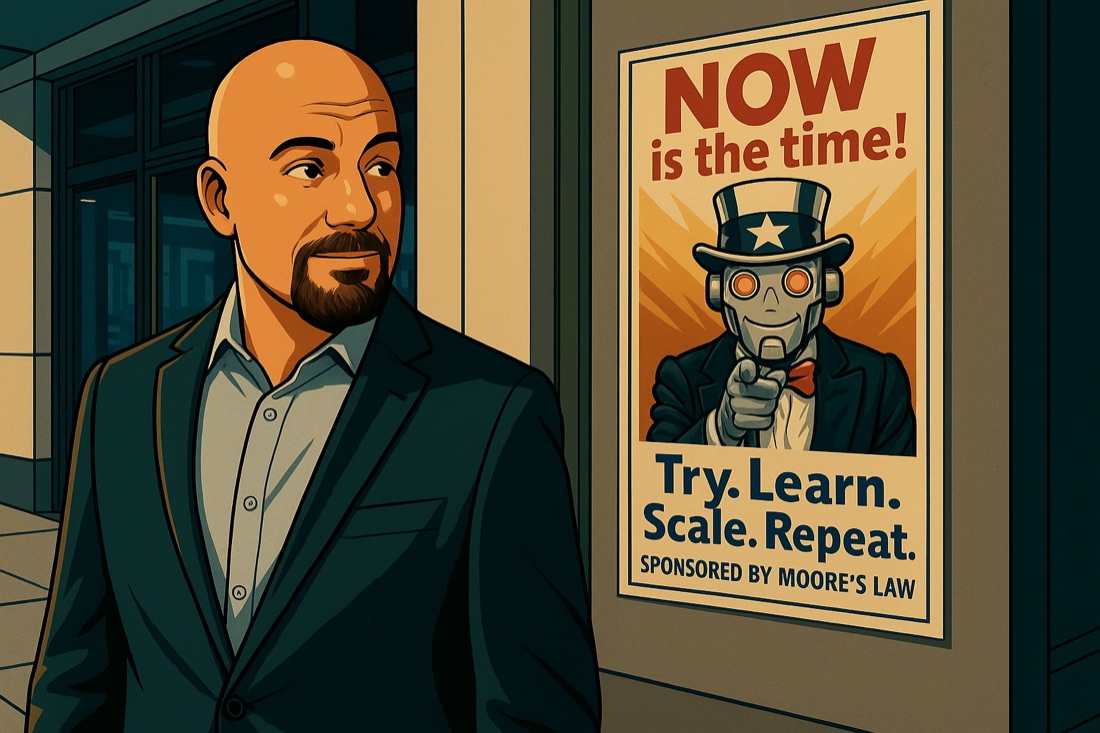
Moore’s Law, Meet AI: Why Waiting 6 Months Is a Mistake
In technology, speed has always mattered. But with artificial intelligence, we’re not just moving fast, we’re accelerating. AI isn’t evolving in predictable, incremental steps. It’s leaping forward in exponential bounds. According to recent studies, the capabilities of leading AI models are now doubling every 6 to 7 months. For comparison, Moore’s Law, the gold standard of computing advancement for decades, predicted that computing power would double roughly every two years. AI is shattering that baseline.
Moore’s Law Was the Baseline. AI Is the Breakout.
For decades, Moore’s Law gave business leaders a reliable tempo for decisions around IT infrastructure, product development, and workforce planning. But AI doesn’t move at the same tempo. Its curve is much steeper and even more disruptive. Tasks that once took a team of analysts a week can now be handled by a single AI agent in under an hour. What once required coordination now runs on intelligent automation, whether it's writing policies, reviewing contracts, or validating data across disparate systems. Innovation hasn’t just accelerated; it's compressed. What once took quarters now happens in weeks, or even days. This shift demands a different kind of leadership: one that plans less rigidly, learns on the fly, and makes decisions amid uncertainty. The winners in this new era won’t be the most cautious; they’ll be the most adaptive. AI isn’t waiting, and neither should we.
The Compounding Effect of AI Maturity
What separates AI leaders from AI laggards isn’t just adoption; it’s iteration. The most effective teams treat AI not as a one-time project, but as a continuous capability. They follow a simple but powerful framework: Try a use case Learn what works (and what doesn’t) Scale what adds value Repeat, faster each time This framework builds momentum. Teams that began experimenting in 2023 are now moving faster, encountering fewer bottlenecks, and making sharper strategic decisions. They’ve built the muscle memory and skills to work alongside AI, prompting effectively, integrating confidently, and approaching the technology as a co-worker, not a competitor. And just like compound interest, the earlier you start, the greater the return.
The Risk of Strategic Paralysis
The greatest risk today isn’t implementing AI poorly. Quite frankly, the risk is failing to act. It's apparent that many leaders are stuck in the same loop: Waiting for more budget Planning for the “perfect” rollout Getting lost in governance models before they’ve even run a single test But in today’s environment, hesitation is a decision, and often the wrong one. As the Marine Corps warfighting doctrine states: “Any decision is generally better than no decision.” And more pointedly: “We will not accept lack of orders as justification for inaction.” That mindset isn’t just for the battlefield; it’s for every environment where timing and initiative shape the outcome. While some teams debate and defer, others are building. A competitor solves the problem first. A startup delivers with AI-enhanced solutions. A customer’s expectations shift, and your current process can no longer keep up. Six months ago was the time to start. But the second-best time is now.
What Leaders Can Do Right Now
You don’t need a 12-month roadmap to get started; you need a single use case. Start small by identifying a friction-heavy process, one that eats up time, energy, or accuracy. Use ChatGPT to draft or refine a clear, structured standard operating procedure (SOP). Then build a lightweight prototype using a low-code, agentic tool. From there, observe how it performs, adjust based on feedback, and continue refining. Each small experiment becomes an asset, building the muscle needed to thrive in today’s fast-moving business environment. Every cycle strengthens capability. This new framework isn’t about rolling out AI enterprise-wide overnight; it’s about creating a flywheel of experimentation, learning, and iteration that compounds over time.
Leaders must foster a culture where testing is expected and shared learning becomes part of how the team grows.
Moore’s Law Predicted Progress. AI Is Delivering Revolutions.
Moore’s Law offered a roadmap, and AI is now rewriting it. The gap between those who act and those who hesitate is widening, not because the tools are scarce, but because the skills, insights, and competitive advantages compound with every experiment. The longer you wait, the more ground there is to make up. There won’t be a perfect moment to begin. But six months from now, the leaders who started will already be ahead, hiring faster, learning faster, and scaling smarter. So, which camp are you in: action or inaction? If you're hesitating to get started, let's connect and see how I can help you embrace AI. 4 · 2 reposts
Originally on LinkedIn ·
© 2025 Wade Hudson. All rights reserved. Share the link or quote a short excerpt with credit, but please don’t republish this article without permission.