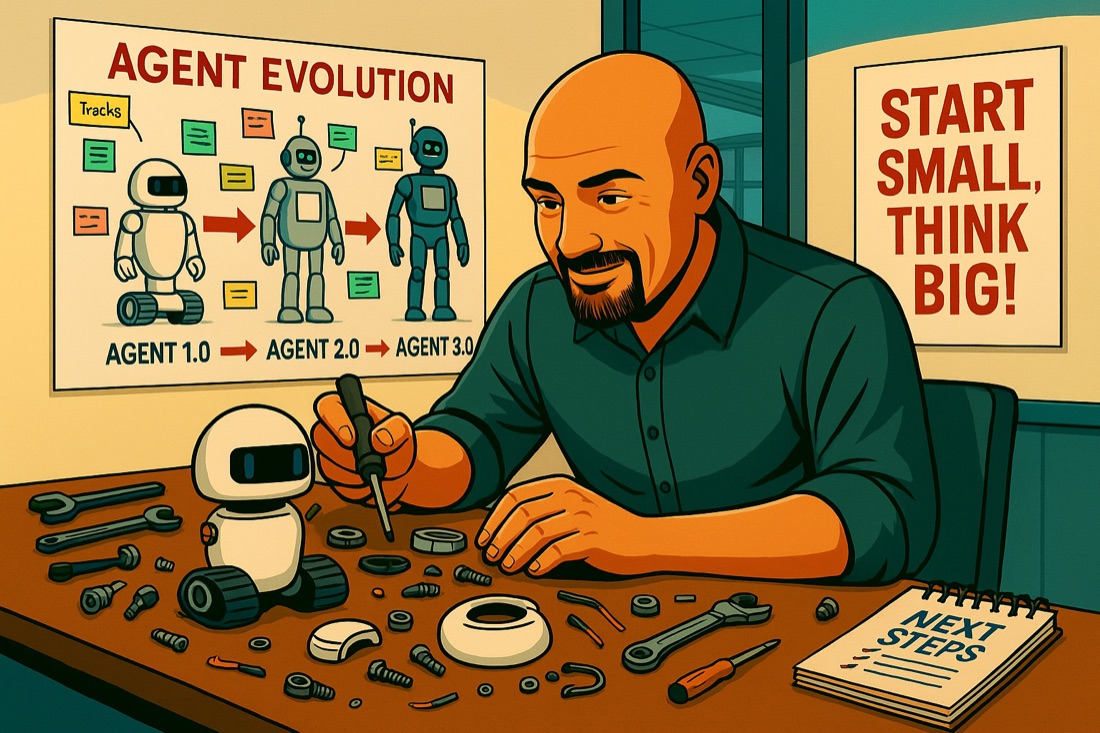
Start Small, Think Big: How to Scale AI Without Losing Focus
For business and operations leaders, the real question around AI isn’t whether you should be using it, but how to start in a way that actually adds value, and how to grow it without introducing unnecessary complexity or upsetting your customers. In my own work building AIpowered workflows and launching our company, I’ve focused less on flashy use cases and more on applying automation where it solves a real problem, improves reliability, and gives the team time back. I’m not claiming to have all the answers, but I have learned a lot about what makes early AI efforts sustainable, and what makes them scalable. This article is about those early lessons and the principles I’m applying to build systems that are useful today and won’t become a mess tomorrow.
Start Small, But Start Smart
One of the biggest challenges at the beginning is resisting the urge to over-engineer. When you’ve got access to the latest AI tools, it’s easy to chase complexity or try to automate everything at once. But, from my experience in operations and the military, complexity tends to create confusion, and confusion kills clarity, trust, and adoption. Instead of thinking big from day one, I’ve found more success by solving specific, tangible problems. That’s meant building surgical, lightweight workflows focused on clear tasks and outcomes. These weren’t designed to be revolutionary; they just needed to be useful. Privacy - Terms
To build this way, I learned by watching others, experimenting, and iterating. When something didn’t work or broke unexpectedly, my default wasn’t to add more logic; it was to simplify. Could I achieve the same outcome with a more proven approach? Could I reduce the number of steps or switch to a simpler tool? Over time, that mindset has helped me move faster and build smarter. Small workflows give you something concrete to test, improve, and replicate. They highlight the gap between how work is designed and how it actually gets done, and they help create repeatable patterns that AI can support, scale, and standardize without adding unnecessary complexity.
Scaling Is a Series of Decisions, Not a Switch
When people talk about scaling AI, it often sounds like a matter of flipping a switch. In reality, it’s a more deliberate and iterative process. Scaling is a series of decisions you define early, similar to how you’d approach version control or building a minimum viable product (MVP). That’s why starting with a solid, simple foundation matters. Structure, naming conventions, version control, and error logging may sound like boring details, but they’re the difference between a system that survives and one that breaks the moment someone else tries to use it. If I can’t explain what a workflow does, or if the workflow fails and I can’t figure out why, it’s not ready for scale. That might mean moving slower at the start, but that early discipline prevents far more timeconsuming rebuilds later. Scaling also means anticipating handoffs. A working system that only you can operate isn’t scalable, even if it runs perfectly. If you’re building AI into your operations, it’s safe to assume that someone else will need to monitor, troubleshoot, or adapt it. Designing with that in mind means using simple logic, plain-language documentation, and reusable modules. That's what makes scaling realistic and sustainable, not just aspirational.
Think Big Without Getting Ahead of Yourself
Thinking big isn’t about automating everything. It’s about making small systems reusable across people, teams, and the organization. I’ve started to view “scalable” in terms of whether a solution can adapt to multiple use cases, integrate with other workflows, and be handed off without issue. That might look like using consistent architecture to keep agents modular, such as building reusable nodes in n8n that can be dropped into different workflows. It also means designing them to be adaptable as needs or systems evolve, like configuring variables and reusing them instead of hardcoding platform-specific logic. Ensuring smooth handoffs depend on building with transparency and visibility in mind. That starts by logging every decision and output, so you can troubleshoot at scale without digging through spaghetti logic or chasing down one person to explain a fix. It also means designing workflows that are explainable to non-technical users, whether it’s a client, a teammate, or a business leader. Transparency builds trust, and trust drives adoption. Scaling starts with building a solid foundation. If that first workflow is held together by copy-paste logic and hidden edge cases, scaling will likely amplify the very problems you’re trying to solve. But if it’s clean, well-documented, and built with reuse in mind, it becomes a foundation others can build on and reliably grow.
Final Thought: Small Wins That Make Space for Bigger Ones
The biggest progress I’ve seen doesn’t come from sweeping change. It comes from a series of small wins that gradually reduce noise, eliminate rework, and build trust with the team. Over time, those wins stack up, and more importantly, they create the space and confidence to go further. So yes, start small. But think bigger with every iteration. The goal isn’t to automate everything. It’s to automate the right things in a way that scales, supports the team, and frees you up to focus on what actually needs your attention. If you’re working through a similar process, whether you’re testing AI use cases, building out agentic workflows, or looking for ways to scale without adding complexity, I’ll be sharing more of what I’m learning along the way. My goal is to move beyond theory and highlight what actually works in practice. If that’s useful to you, I’d love to stay connected.
Originally on LinkedIn ·
© 2025 Wade Hudson. All rights reserved. Share the link or quote a short excerpt with credit, but please don’t republish this article without permission.