Wherever You Are in Your AI Journey, You're Not Alone
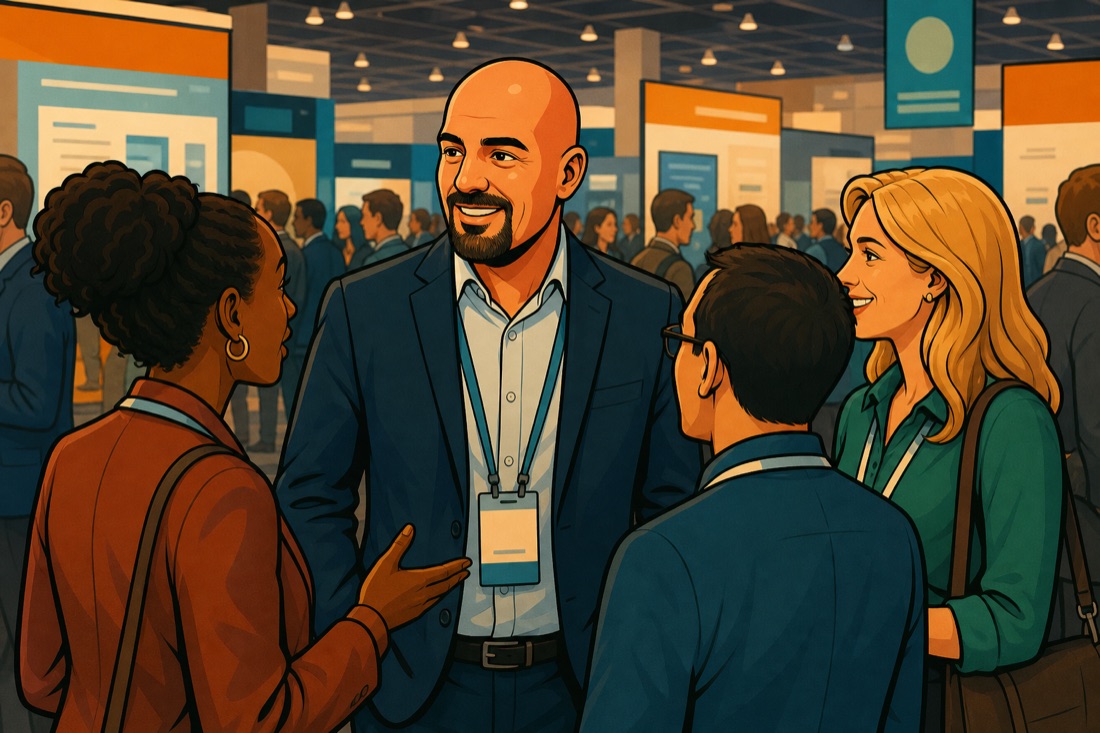
A few weeks ago, I spent a few days on the floor at PBSA, the background screening industry's biggest annual conference, with my co-founders Bill and Justin. We talked with people from dozens of organizations, from screening companies to housing authorities to vendors we'd never met in person before. And if there was one thing that stood out more than any pitch we made or any product we demoed, it was this: everyone is somewhere wildly different in how they're actually using AI.
The Full Range, in Three Days
At one end, I talked with people whose organizations don't allow employees to log into an AI tool at work at all. Not a policy debate, just a flat no, driven by some mix of caution, unresolved data concerns, and not having gotten around to deciding yet.
Far more common were the conversations somewhere in the middle. A team experimenting quietly on their own time. A single department piloting something useful without much support from above. A leader personally convinced AI mattered, but unable yet to get the budget or the buy-in to go further than a few scattered tests. Genuine curiosity and real interest, paired with just as much uncertainty about where to actually start, or whether it was worth the risk of getting it wrong in public.
And at the other end, in exactly one conversation out of dozens, I met an organization that had gone all the way: a structured AI curriculum every employee was expected to complete, a weekly budget each person could spend on AI tools, and a requirement that everyone ship a working project using what they'd learned. Full commitment, from the top down.
That conversation was the exception. Not the rule.
Why That Spread Is the Actual Story
It would be easy to read that range and conclude some organizations are simply behind. I don't think that's right. What it actually tells me is that nobody has this fully figured out yet. The field is still being built in real time, by people making different bets about pace, risk, and where to spend their attention first. The organization with the mandatory curriculum isn't necessarily right. They're just further along one particular bet, and it will take time to know how it plays out.
That distinction matters, because I think a lot of operators quietly assume everyone else is further ahead than they are. They see a LinkedIn post, hear about a competitor's pilot, and start to feel like they're the ones falling behind. Three days of real conversations told me the opposite. Wherever you are in your own organization's AI journey, there's someone else in almost the exact same spot: curious, a little behind where they'd like to be, genuinely unsure what's actually worth doing next.
The Caution Makes Sense. The Risk of Waiting Doesn't.
In the screening industry, the hesitation runs deeper than general AI nervousness, and it should. Background screening produces consequential outcomes for real people. Someone gets the job or doesn't. Someone gets the apartment or doesn't. Turn a system loose on that kind of decision with no guardrails, no traceability, and no way to catch what it got wrong, and you have handed yourself a serious problem. The caution I heard at PBSA was not ignorance. In most cases, it was people taking the stakes seriously.
But here's a working theory we talk about often at TNDM, and I'll be upfront that we have a commercial interest in it, so weigh it accordingly. Right now the risk everyone is bracing for runs in one direction: you used AI, and it got something wrong. That's the headline people are trying to avoid. Our theory is that the asymmetry doesn't hold forever. At some point, a significant error on a background check is going to get real attention, and it will turn out a person made it, working manually through volume that no human could reasonably be expected to check perfectly. And then the question being asked will flip. Not why did you use AI, but why wasn't AI used? Why was there no system double-checking this work?
My co-founder Bill has a story from early in his career that makes this point better than I can in the abstract. At a prior company, rolling out one of its first AI-based projects, an executive at the time was skeptical, and frankly frustrated, by the system's error rate. Bill's response was to ask a different question: forget whether the AI was perfect, how did it compare to the humans doing the same work today? The answer was that the manual process was running a meaningfully higher error rate than the system it was being compared against. The AI wasn't flawless. It was already better than what it was replacing. The frustration had been aimed at the wrong number.
I don't know when that same realization hits the screening industry at large, and I certainly won't try to predict it. But I think it's worth sitting with, because it reframes what caution actually means. Doing nothing isn't a neutral position that carries no risk. It's a bet too, with its own exposure, and it deserves the same scrutiny we'd apply to moving fast.
The One Thing Worth Doing This Week
If there's a single practical takeaway from all of this, it isn't a tool to buy or a vendor to call. It's simpler than that: talk to your own network.
Ask people directly what they're actually doing with AI, not what they've heard about or plan to try eventually. Ask how it's working, where it's helped, and where it hasn't. And just as importantly, ask the people who aren't doing anything yet why not. That answer is often more useful than the success stories, because it tells you what's actually stopping adoption, whether that's trust, unclear value, or just not having the time to figure it out.
Do that enough times, with enough people, and you start building something more valuable than any single case study: your own working picture of where AI is actually creating value, where it's mostly hype, and where it might apply to your own business, or honestly, your own life. That's a far better foundation for a decision than copying whatever the most visible company in your industry happens to be doing.
© 2026 Wade Hudson. All rights reserved. Share the link or quote a short excerpt with credit, but please don’t republish this article without permission.